|
Extended Pascal is a
language designed to meet the needs of serious developers, and is
defined in US & International standards. It
greatly increases the range of the traditional "classic"
Pascal language without compromising its essential qualities of
security and maintainability. There are enhancements which make the
language simple to use, such as relaxed order of declarations and
constant expressions, and major features including:
-
Secure modular program construction
-
Dynamic strings and string operations
-
Direct-access files and file binding
-
Run-time selection of types
-
Array and record constructors
-
Structured function results
-
Initial values of variables and fields
-
Complex arithmetic and functions
-
Date and time facilities
The standards committees have also defined in a Technical Report a set
of Object Oriented extensions which are not part of the formal
standards. The emphasis throughout is on providing orderly and
coherent answers to practical problems. The modular programming
facilities are suitable both for project development and for
libraries; types, constants, variables, procedures and functions can
be exported from modules, and then be imported by other modules or
main programs. There are options for selective import, renaming to
eliminate clashes, and protection of exported variables. Dynamic type
selection allows array or string sizes, for instance, to be defined at
run time. An initial value may be given as part of a variable or field
declaration, or may be associated with a type and given to variables
or fields of that type.
Prospero Extended Pascal provides the complete Extended Pascal
language, including the Object Oriented additions, together with
object-style exception handling using try statements. Pascal programs
have access to an extensive library of additional routines, and can
make direct calls on API functions.
|
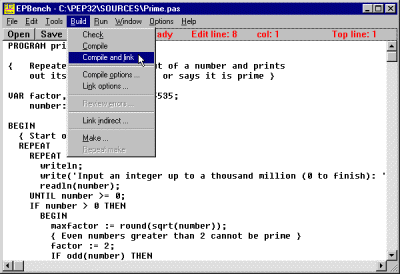
The package includes:
-
32-bit Extended Pascal compiler and linker
-
Programmer's workbench (IDE)
-
Symbolic debugger
-
Pascal run-time libraries
-
"Make" and conversion utilities
-
400+ page user documentation
The programmer's workbench is tailored to the requirements of program
development, and provides a working environment which makes it quick
and easy to compile, link and debug. The workbench gives integrated
access to the "make" program Promake and the symbolic
debugger Probe; it also provides for searching indexes of cross-module
references and API definitions.
With Probe, the source-level symbolic debugger, the programmer can
work through an executing program at the source line level, displaying
or altering variables, setting breakpoints or watching for conditions
to arise, and displaying the recent execution and call histories.
The Promake utility can be invoked either from the workbench, or from
a command line or batch command. The control file can employ macros
and implicit commands. There is a general-purpose textfile
preprocessor, and programs to convert the C-language headers output by
resource editors, and to assist in the translation of existing source
code.
|


